
audiobook production checklist: unearthing your story for the ears
Most indie authors treat audiobook production like a secondary chore rather than the high-stakes mining operation it truly is. You have spent months unearthing your narrative, so you know that a professional sound is the difference between a hidden gem and a pile of rubble. It's frustrating when technical specifications and the fear of hiring the wrong narrator bury your progress under layers of uncertainty. We understand that bridging the gap between a finished manuscript and a polished Audible listing feels like navigating a dark tunnel without a headlamp.
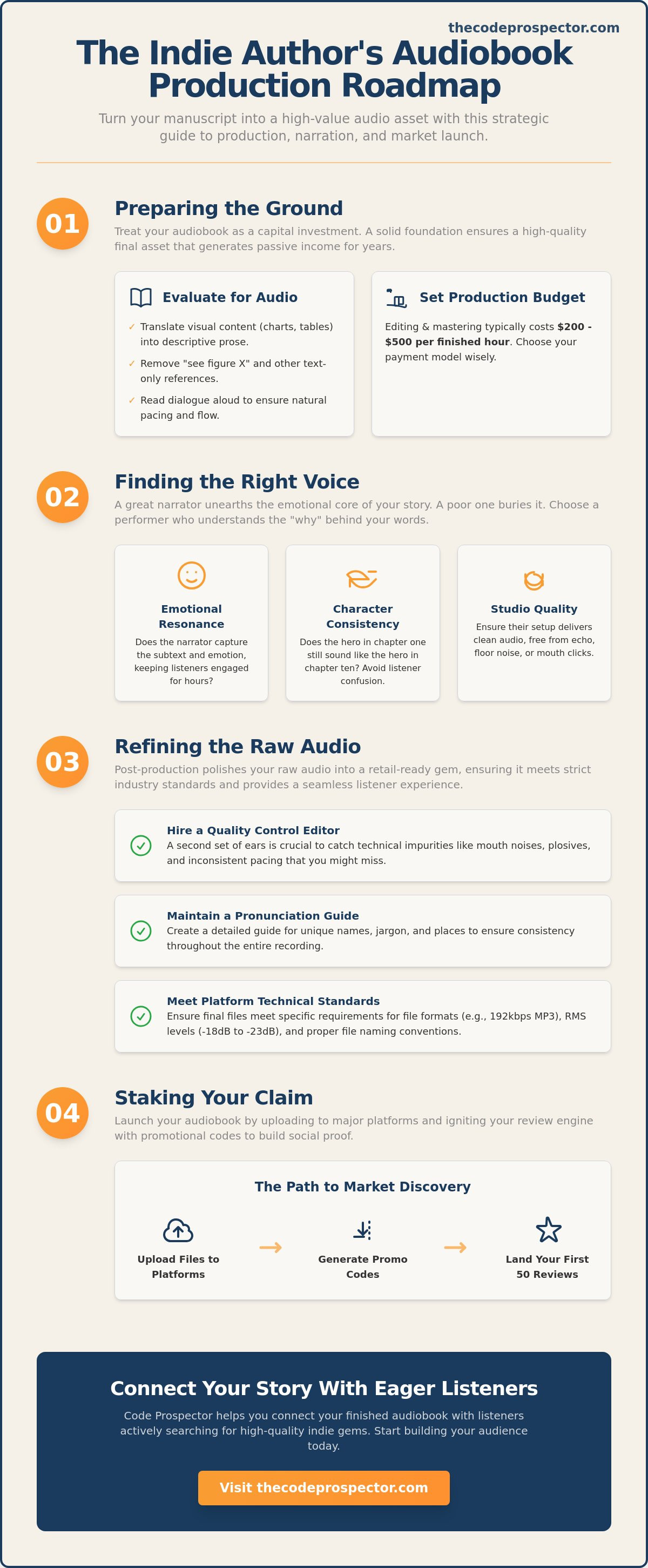
This checklist guides you through the technical and creative phases of audiobook production to ensure your final asset is ready for market discovery. We will show you how to calculate your production costs, meet strict industry file standards, and implement a strategy to land your first 50 reviews using Code Prospector promo codes. This roadmap prevents you from wasting your budget on poor narration or files that fail the first review. By following these steps, you can confidently turn a silent file into a high-value asset in the Code Prospector catalog.
Key Takeaways
- As an indie author, you must treat your manuscript as a high-value asset by approaching audiobook production as a strategic capital investment.
- Conduct a prospecting mission for the perfect narrator by evaluating auditions for emotional resonance and character consistency.
- Remove technical impurities from your raw audio by hiring a quality control editor and maintaining a detailed pronunciation guide.
- Upload your files to distribution platforms like Audible and generate promo codes to start your review engine.
- Visit our for-authors section to see how we help you connect your finished story with listeners who hunt for high-quality indie gems.
preparing the ground for your audiobook production
You want to turn your written words into a high-value audio asset that earns royalties while you sleep. Audiobook production is the process of extracting the gold from your manuscript and refining it into a retail-ready digital product. We view this transition as a capital investment in your intellectual property rather than a simple expense. You are building a permanent piece of infrastructure that generates passive income for years to come.
Understanding the History of audiobooks reveals how this medium evolved from vinyl records to the massive digital industry we see today. Modern authors must treat their audio files like refined ore, ready for distribution on platforms like Audible. Success begins with identifying the most valuable "vein" in your catalog to convert first.
To better understand this concept, watch this helpful video:
evaluating your manuscript for audio
Not every manuscript is ready for the microphone without a bit of digging and clearing. You must identify visual-heavy content, such as charts or complex tables, that will confuse a listener. These elements require a translation into descriptive prose or an accompanying PDF supplement. Strip away hyperlinked text and "see figure x" references that break the narrative flow for someone listening in a car.
Write a single sentence that defines the "audio-first" version of your book to keep the project focused. This sentence acts as your compass during the recording phase. It ensures that the narrator captures the emotional core of the story without getting tripped up by technical jargon that only serves the eye. We recommend reading your dialogue out loud to ensure the pacing feels natural for a human voice.
setting your production budget
Your budget dictates the quality of the final "assay" or quality control of your audio. You can choose between a pay-for-production model, where you pay a flat fee, or a royalty share agreement with your narrator. A flat fee gives you total control over future earnings, while royalty sharing reduces your upfront financial risk. Both paths require a professional mindset toward your audiobook production costs.
You must account for the specific line item of how much does it cost to hire an audiobook narrator to avoid unexpected debt. Professional editing and mastering costs usually range from $200 to $500 per finished hour in the current market. These costs cover the technical labor of removing mouth noises and ensuring the files meet strict retail standards. Code Prospector helps authors maximize this investment by connecting them with reviewers in our catalog who provide the social proof needed for a strong launch.
Allocate additional funds for the initial marketing push and the distribution of promo codes. These codes are essential for gathering early feedback and climbing the sales charts on major platforms. Treat your budget as a blueprint for a structure that will stand for decades. Your next step is to finalize your manuscript edits before you approach a single narrator.
finding the right voice to mine your manuscript
You spent months polishing your prose, but a poor narrator will bury your work under layers of sonic rubble. Finding the right voice requires the same precision as a prospecting mission for high-grade ore. You must look past a pleasant tone to find a performer who mirrors the emotional core of your story. Use the audition process to unearth a narrator who understands the specific "why" behind your words.
Listen for character consistency across different scenes. A narrator who sounds like a hero in chapter one but loses that grit by chapter ten creates technical debt for your listeners. We recommend evaluating auditions based on how well the performer captures the subtext of your dialogue. This emotional resonance is what keeps a listener engaged for 10 hours or more through your audiobook production journey.
High quality audiobook production demands a clean signal path. Ask your potential narrator about their studio setup to ensure they can deliver audio free from floor noise, room echo, or mouth clicks. Dirty audio requires expensive post-production fixes that eat into your royalties. You are looking for a professional who treats their recording booth like a precision laboratory.
Discuss the rights and contracts before any recording begins. You must be clear about whether you are paying a flat fee (Per Finished Hour) or entering a royalty share agreement. Secure these details early to avoid legal cave-ins later in the process. Clear communication at the start ensures a smooth path from the manuscript to the finished file.
the audition checklist
Request a 15 minute sample of a high action or high emotion scene to test the narrator's range. Listen for consistent pacing and the correct pronunciation of any technical terms or invented names. You must also verify the narrator can deliver the specific accents your characters require without sounding like a caricature. A single mispronounced word can pull a listener out of the story instantly.
contracting your crew
Stipulate a firm deadline for the first 15 minutes of finished audio to ensure the tone is correct before they record the full book. Define the number of revision rounds included in your base price to avoid unexpected costs. Always confirm in writing that you retain all rights to the final audio files for distribution on platforms like Audible. If you need help finding reviewers once your files are ready, explore our author membership options to start your marketing journey.
navigating the recording and extraction phase
As an indie author, you are finally descending into the tunnels of the recording booth to extract the raw material of your story. This phase of audiobook production requires you to act as a foreman, overseeing the quality of the ore as it reaches the surface. You must monitor the "first 15" minutes of recorded audio with extreme care. This initial sample serves as your project's North Star, ensuring the narrator’s tone and pace align with your creative vision before they record the remaining 80,000 words.
You should maintain a living pronunciation guide to avoid costly re-records. List every fictional name, technical term, and location in a shared spreadsheet for your narrator. If a narrator mispronounces a recurring character's name for ten chapters, the correction process becomes a logistical nightmare. We recommend keeping a log of script changes during the session. Narrators often make minor adjustments for better flow, and tracking these ensures your final manuscript matches the audio file perfectly.
Understand the difference between raw recording time and finished hours. Most narrators charge per finished hour (PFH), which is the length of the final, edited product. A standard 10,000-word chapter typically yields about 65 minutes of finished audio. However, the narrator may spend three hours in the booth to produce that single hour of clean content. Tracking these ratios helps you manage your budget and timeline with precision.
managing the narrator relationship
You need to provide feedback on all audio samples within 48 hours to maintain momentum. When you identify an error, use specific time stamps like 12:45 to point out the exact word or phrase. This precision allows the narrator to perform "pickups" or corrections without searching through hours of tape. Once you establish the tone in the first 15 minutes, step back. Avoid micromanaging the performance, as constant interference stifles the creative energy of your narrator. At Code Prospector, we find that authors who trust their narrators often end up with a more polished final product.
technical standards for extraction
Every file you upload to platforms like Audible must meet strict technical benchmarks. Ensure your files maintain a volume level between -23db and -18db RMS (root mean square). Each chapter requires its own separate file, beginning with 1 to 5 seconds of room tone or silence. You must also verify that the audio is free of mouth clicks or background hum. If you need a partner to help you navigate these technical hurdles, you can find resources on our for-authors page. High standards during the extraction phase ensure your audiobook production results in pure gold rather than digital rubble.
refining the raw audio through post-production
As an indie author, you know that raw narration is just unrefined ore that requires careful smelting. To turn your audiobook production into a polished asset, you must enter the post-production phase. This process removes technical impurities like mouth clicks, inconsistent room tone, and background hiss. If your narrator does not provide a dedicated quality control editor, you should hire one to ensure your story shines without distraction.
A professional editor acts as your steady hand in the dark, finding the hidden flaws that could devalue your work. You want a final product that feels like a seamless journey rather than a series of disjointed clips. This stage is where you transform a rough recording into a high-value asset that listeners will actually buy. Removing the "rubble" of technical debt now prevents expensive revisions after you launch.
the quality control audit
You must treat this stage of audiobook production with the same rigor a prospector applies to a gold strike. You need to listen to the entire book at least once to find missed edits or pacing issues. Ensure the audio matches your final manuscript exactly to provide a professional experience for your audience. Listeners notice when a narrator skips a word or mispronounces a character's name, which can lead to negative reviews.
Your retail sample serves as your primary sales tool in the Audible marketplace. It should highlight the most compelling part of your story rather than just the first five minutes of the introduction. We suggest choosing a scene with high emotional stakes or a unique narrative hook to grab attention. This five-minute clip is often the only thing standing between a potential listener and a completed sale.
final mastering requirements
Technical precision is the bedrock of a successful distribution strategy for any indie author. You must verify that your mp3 files maintain a constant bit rate of 192kbps or higher. Confirm that every chapter uses a 44.1 khz sample rate before you attempt to upload to any platform. These specifications ensure your audio sounds consistent across all devices, from high-end home systems to budget earbuds.
At Code Prospector, we understand that preparing files is only half the battle for independent creators. You can see how we help authors connect with listeners once your files meet these rigorous standards. We provide the tools you need to unearth your story's true value in a crowded market. Our membership platform bridges the gap between your finished master and the listeners who crave new stories.
staking your claim with distribution and promo codes
Indie audiobook authors often mistake the end of recording for the end of the journey. You have polished every syllable and mastered every file, but your story remains buried until you place it where listeners can actually find it. Transitioning from the labor of audiobook production to the active phase of prospecting requires a shift in mindset. You are no longer an artist in a booth; you are now a prospector claiming your territory in a crowded market.
The first step involves uploading your finished files to your chosen distribution platform, such as ACX for Audible or Findaway Voices for a wider reach. Do not rush this technical handoff. Ensure your retail sample captures the listener within the first 30 seconds of playback. This is the moment you stop refining the past and start digging for the future of your sales.
setting up for sales
Your metadata acts as the map that leads listeners to your treasure. Write an audiobook description that focuses on the auditory experience, mentioning the narrator's specific tone or the immersive quality of the sound design. Choose your categories with precision to avoid getting lost in broad, over-saturated genres. You can explore more about beyond production: turning your audiobooks for sale into profit streams to refine your long-term strategy.
Keywords are the veins of gold that search engines follow. Select terms that reflect what listeners actually type into a search bar, such as "full cast narration" or "slow burn romance." These specific markers help the right audience find your work among thousands of other titles. Accurate tagging ensures your audiobook production efforts result in actual royalties rather than digital dust.
unearthing reviews with code prospector
The first 30 days after your release are the most critical for building a foundation of visibility. You should generate your initial batch of 25 to 50 promo codes from your distributor and prepare to get them into the hands of listeners immediately. Reviews act as the social proof that convinces a stranger to spend a credit on an unknown author. Without a foundation of honest feedback, your title will likely languish at the bottom of the search results.
We help you manage this process by connecting you with a verified network of listeners who enjoy your specific genre. You can distribute your promo codes through our platform and track redemptions to see which listener segments show the most activity. This data tells you exactly where the value is hidden for your specific voice and style. It removes the guesswork from your marketing and lets you focus on your next project while the reviews roll in.
Stop sending codes into the void and start building a sustainable listener base. We invite you to signup today to start managing your distribution and unearthing the reviews your story deserves.
Claim your stake in the audiobook market
You have successfully navigated the dark tunnels of audiobook production by mining your manuscript and refining raw audio into a polished gem. Now, you must move from the extraction phase to the marketplace. Your distribution strategy determines whether your story sits in a quiet corner of Audible or reaches the ears of eager fans. Tracking your promo codes and managing listener feedback are the final tools you need to secure your return on investment.
We built Code Prospector to help you manage this critical final mile. Our platform provides a specialized dashboard for tracking your promo code inventory, ensuring you never lose sight of your digital assets. You gain direct access to a verified network of real listeners who provide the honest reviews you need to climb the charts. Our team offers specialized support for indie authors who are ready to turn their hard work into a sustainable career.
The journey from a written manuscript to a successful audio release requires grit and the right partners. You have done the heavy lifting of recording and editing. Now it's time to ensure your story finds its audience. start prospecting for listeners and reviews today
Frequently asked questions
How much does professional audiobook production typically cost?
If you are an indie author preparing to enter the recording booth, these answers will help you navigate the complexities of audiobook production. Professional production usually ranges from $200 to $500 per finished hour (PFH) according to data from the Editorial Freelancers Association. This investment covers the narrator's fee and the engineering work required to polish the raw audio. You are essentially prospecting for quality, so expect to pay a premium for narrators with established home studios and proven track records.
Can i produce an audiobook myself in a home studio?
You can produce an audiobook at home if you invest in a cardioid condenser microphone and a sound-treated space with a noise floor below -60dB. While this saves on upfront costs, the learning curve for editing and mastering is steep for many authors. We often see authors spend 40 hours of labor for every 10 hours of finished audio when they handle the technical mining themselves. If you don't have the patience for deep-track editing, hiring a pro is the smarter move.
How long does the entire production process take from start to finish?
A standard 80,000-word audiobook takes approximately 6 to 8 weeks to move from the first recording session to the final retail upload. This timeline includes the initial narration, the proofing phase where you identify errors, and the final mastering. If you use the Code Prospector community to find early listeners, you should factor in an additional 14 days for review generation before your official launch. Planning your release schedule around these milestones prevents your project from stalling in the dark.
What is the difference between acx and wide distribution?
ACX exclusive distribution pays a 40% royalty but limits your reach to Audible, Amazon, and iTunes. Wide distribution through aggregators like Findaway Voices or Draft2Digital allows you to sell on 40 or more platforms including Spotify and local libraries. Choosing wide distribution reduces your royalty to 25% on Amazon but opens up different veins of revenue across the global market. You must decide if you want the high-yield of a single mine or the broad reach of an entire mountain range.
Is it better to use a human narrator or ai for production in 2026?
Human narrators remain the gold standard for fiction because they capture the emotional subtext that AI still struggles to replicate in 2026. While synthetic speech technology has improved, listeners often report listener fatigue after 30 minutes of non-human narration. You should prioritize human talent to ensure your audiobook production feels like a genuine connection rather than a mechanical output. High-value stories deserve the warmth of a real voice to unearth their true meaning.
How do i get my first reviews after production is complete?
You can secure your first reviews by distributing promo codes to verified listeners through the Code Prospector platform. We connect authors with a dedicated catalog of reviewers who provide honest feedback in exchange for early access to your work. This method helps you build social proof on Audible within the first 30 days of your release. Building this initial momentum is like finding the first nugget of gold that proves your claim is worth the effort.
What are the specific technical requirements for audible files?
Audible requires files to be 192kbps or higher, CBR, with a sampling rate of 44.1 kHz. Each file must contain between 0.5 and 1 second of silence at the beginning and 1 to 5 seconds at the end. These strict parameters ensure your audio doesn't hit a dead end during the quality assurance process. We recommend running your files through the ACX Audio Analysis tool to catch any peaks that exceed -3dB before you submit your work.
Should i narrate my own audiobook if i am the author?
You should narrate your own book only if you have professional acting training or if you are writing a memoir where your specific voice adds unique value. Most authors find that performing their own work is more exhausting than writing it, as it requires consistent energy for 6-hour recording blocks. Hiring a professional narrator is often the more pragmatic path to unearthing the true potential of your story. Let the expert handle the heavy lifting while you focus on prospecting for your next great plot.
Visit our for-authors page to learn how Code Prospector can help you connect with your first listeners today.

Article by
Kimberly Cordova
Kimberly Cordova is the founder of Code Prospector, the membership platform where indie audiobook authors distribute Audible and Findaway Voices promo codes to listeners who actually want to leave honest reviews.
She started Code Prospector after watching too many indie authors pour a year into producing an audiobook, launch it, then disappear into the void without the reviews they needed to stay visible. The books were not the problem. The review ecosystem for indie audiobooks simply did not exist. So she built one.
On the blog, Kimberly writes about what actually works for indie audiobook authors: review strategy that does not feel sleazy, promo code distribution that respects Audible's terms, catalog positioning, and the marketing moves that keep a title selling long after launch. She also writes for listeners, because listeners are the reason the whole platform works. Her focus is practical, honest, and rooted in what real authors and real audiobook fans are actually doing, not theory or recycled marketing advice.
Kimberly also runs Thrive Collective, a portfolio of publishing and creative businesses, which keeps her in the weeds of indie publishing, audiobook marketing, and community building every day. She believes indie authors deserve better tools, better promotion, and a review ecosystem that does not require begging strangers on Facebook.
When she is not building Code Prospector, you will usually find her buried in a new audiobook, running ads for her publishing catalog, or overthinking how to make life easier for the people who create and love audiobooks.