how much does it cost to hire an audiobook narrator in 2026?
Spending $3,000 on a professional narrator is often the price of admission for a top-tier production in 2026. You've likely felt the sting of confusion while trying to calculate how much does it cost to hire an audiobook narrator amidst a sea of technical acronyms and shifting industry standards. It's exhausting to prospect for talent when you're worried about hidden mastering fees or narrators who might deliver a low-quality file. We understand that every dollar you invest is a piece of your hard-earned capital that needs to yield a high-value return.
This guide will unearth the current industry standards, which the Audio Publishers Association often benchmarks between $200 and $500 per finished hour. You'll learn how to distinguish between a high-carat professional and a bargain-bin amateur who might leave your production in the rubble. We'll also explore how your production budget connects directly to your success on the Code Prospector platform. We help listeners discover and claim your finished work for honest reviews, so your investment needs to be sound from the start. By the time you finish reading, you'll have a clear, business-minded strategy to fund your next project.
Key Takeaways
- Master the Per Finished Hour (PFH) model to accurately budget for the final length of your audio files instead of the time spent recording in the booth.
- Explore the math behind how much does it cost to hire an audiobook narrator and decide if royalty share paths are the right way to unearth value without upfront fees.
- Factor in the hidden costs of editing and mastering to ensure your production meets professional standards and avoids the pitfalls of poor sound isolation.
- Learn how to prospect for high-quality talent that provides the emotional resonance listeners demand, ensuring your investment yields a genuine profit.
- Build a post-production plan that uses honest reviews and strategic promotion to turn your catalog into a source of recurring gold.
Understanding the per finished hour model
You’ve finished your manuscript and now you want to hear it come to life. Finding the right voice to represent your work is like prospecting for gold in a mountain of raw data. You need to know exactly how much does it cost to hire an audiobook narrator before you start digging into your production budget.
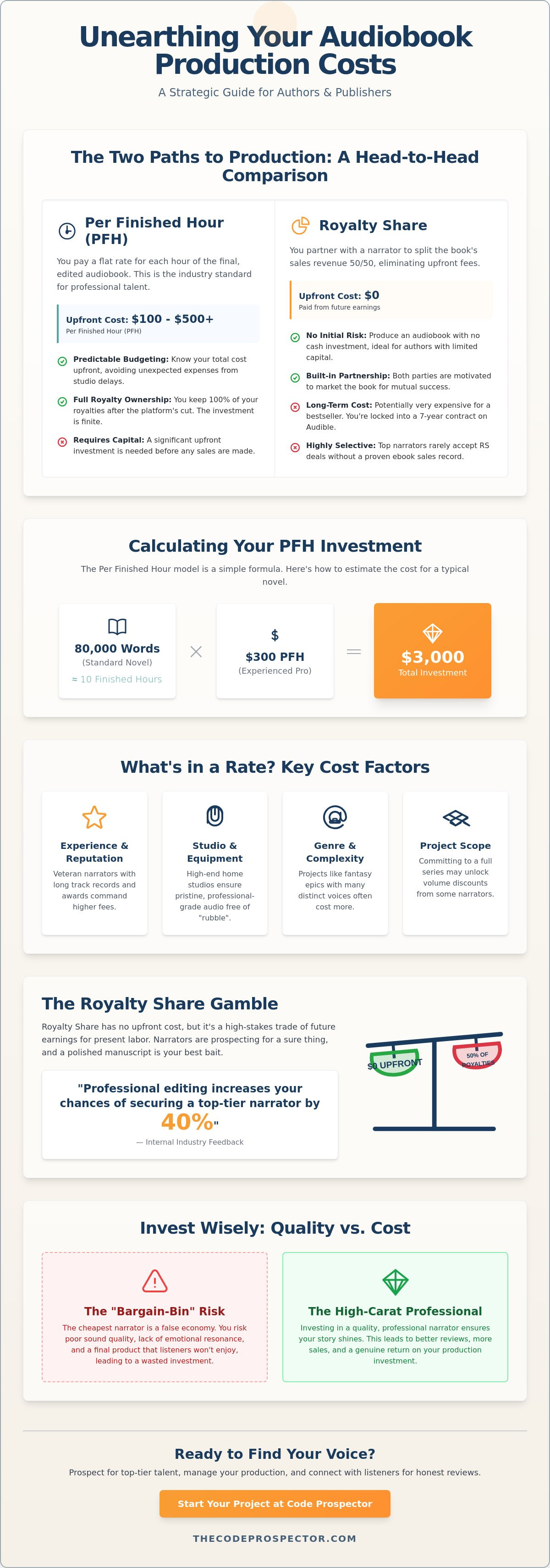
In 2026, the industry relies on the Per Finished Hour (PFH) model to keep costs transparent and projects on track. PFH means you pay for the final length of the audio files, not the actual hours the talent spends recording in the booth. For professional talent, you can expect to pay between $100 and $350 per finished hour. A standard 80,000 word novel usually results in about 10 hours of finished audio.
To better understand this concept, watch this helpful video:
Why PFH is the safest bet for authors
PFH serves as a reliable map through the often dark tunnels of production. Calculating how much does it cost to hire an audiobook narrator becomes much easier when you have a fixed rate that provides predictable budgeting. Professional narrators prefer this model because it guarantees a fair wage for their labor while protecting your bottom line from unexpected studio delays. Under this arrangement, the narrator remains responsible for their own studio time and fixing any mistakes made during the audiobook production process.
What determines a narrator's PFH rate
Experienced narrators with high-end home studios and long track records charge higher premiums for their expertise. They bring a level of technical sophistication that ensures your final files are free of the rubble found in amateur recordings. Genre expertise, such as the ability to perform distinct character voices for a complex fantasy epic, often increases the price. These specialists ensure your story shines and resonates with your target listeners.
If you are prospecting for a long series, some narrators might offer volume discounts for committing to multiple titles upfront. We help indie authors navigate these financial decisions so they can focus on unearthing new stories. Once your audiobook is complete, visit our catalog to see how other authors are presenting their finished work to the community.
Evaluating royalty share and hybrid payment paths
If you want to unearth the value in your manuscript without digging into your cash reserves, royalty share is the primary tool at your disposal. This model removes the barrier of entry for authors who lack the capital for a flat per-finished-hour fee. You and your narrator become partners in a claim, splitting all sales revenue 50/50 through platforms like ACX. While this sounds like a free ride, it's actually a high-stakes trade of your future gold for present labor.
When you're calculating how much does it cost to hire an audiobook narrator, royalty share technically costs zero dollars on day one. However, most narrators who have spent years in the trenches won't touch a project unless they see a proven sales record. They are looking for a vein of gold that has already been tested on the Kindle store. If your book sells 1,000 copies a month, a narrator is more likely to gamble their time on your project.
The pros and cons of splitting the gold
This path reduces your initial financial risk, but it becomes expensive if your book turns into a bestseller. You are locked into a seven-year contract on Audible where half your earnings go to the voice in the booth. Narrators take a massive risk on new authors; so your manuscript must be polished to a mirror finish before you pitch it. Professional editing increases your chances of securing a top-tier narrator by 40 percent based on internal industry feedback.
This model creates a genuine partnership where both parties are motivated to market the book. The narrator isn't just a contractor; they are a stakeholder in your success. They will often share the release with their own listener base to drive early sales. It turns a solo expedition into a team effort to extract maximum value from your intellectual property.
When to choose Royalty Share Plus
Royalty Share Plus (RS+) is the middle ground for authors who want to attract higher-quality talent. You pay a smaller upfront fee, often between $50 and $100 per finished hour, plus the 50/50 revenue split. This upfront payment usually covers the narrator's basic production costs like hiring an external editor or proofer. It signals to the narrator that you are serious about the project and have some skin in the game.
Understanding how much does it cost to hire an audiobook narrator involves looking past the sticker price and considering long-term equity. RS+ helps you find seasoned explorers who cannot afford to work entirely for free. If you are unsure which path fits your budget, you can see how our community supports discovery once your project is live. This hybrid model often yields a better final product because the narrator isn't cutting corners to save on overhead.
Factoring in the hidden costs of production
You might think you are simply paying for a voice when you hire a professional. In reality, you are investing in a complex refining process that turns raw audio into a polished asset. When you calculate how much does it cost to hire an audiobook narrator, you must look beneath the surface of the per-finished-hour rate. Raw audio is like unrefined ore; it requires significant labor to become a marketable product.
Professional narration involves much more than just reading a script into a microphone. This process includes proofing for mistakes, editing out distracting breaths, and mastering the files to meet strict retail standards. Audible and other retailers enforce non-negotiable technical requirements for noise floor and peak levels. If your narrator does not handle these tasks, you must hire an external audio engineer to finish the work.
We see many authors overlook these production layers during their initial budgeting. Neglecting these details can lead to files being rejected by distributors, which delays your launch and adds unexpected expenses. A seasoned narrator acts as a steady hand, guiding your project through these technical tunnels to ensure the final output is flawless. Understanding these hidden steps helps you determine the true value of the quotes you receive.
The labor behind the finished hour
Every one hour of finished audio typically requires three to six hours of real-world work from the production team. Proofers must listen to the raw audio to ensure every word matches your manuscript exactly. This stage is vital for catching misreadings or skipped sentences that could pull listeners out of the story. It is the first level of quality control in the prospecting process.
Mastering ensures the volume levels and noise floor meet retail specifications, such as the -23dB to -18dB RMS range required by ACX. This technical polishing ensures your listeners have a consistent experience across different devices. Without professional mastering, your audiobook might sound quiet or contain distracting background hiss. High-quality mastering transforms a basic recording into a professional gem ready for the global catalog.
Manuscript preparation and research
Narrators must research pronunciations for names, locations, and technical jargon before they ever hit the record button. This preparation prevents costly mistakes that would require the narrator to re-record entire sections later. You can help this process by providing a character voice guide that outlines specific accents or personality traits. This document acts as a map, helping the narrator find the right tone for every scene.
A messy manuscript with typos or inconsistent formatting will slow down production and potentially increase your total costs. Narrators often charge more if they have to navigate a "dirty" script that requires constant clarification. Clean up your text before handing it over to ensure the production moves quickly and efficiently. You can learn more about how we support high-quality productions on our how it works page.
By preparing your manuscript and understanding the labor involved, you can better estimate how much does it cost to hire an audiobook narrator for your specific project. These production steps are the difference between a forgotten recording and a high-value asset that attracts loyal listeners. Treat the production phase with the same rigor you used for writing your book. This commitment to quality ensures your work stands out in a crowded marketplace.
Why the cheapest narrator is often a bad investment
Choosing the lowest bidder often feels like finding a shortcut through a dark tunnel, but it usually leads to a cave-in. You might save money upfront, but you are actually accumulating technical debt that will haunt your royalties for years. When you calculate how much does it cost to hire an audiobook narrator, you must include the price of your reputation. A narrator without a professional booth will leave your audio buried under background noise and digital artifacts.
Listeners have ears like high-precision sensors. They notice every stray dog bark or computer fan hum in the background of your recording. Professional narrators spend years building sound-isolated environments to ensure their tracks are clean and clear. If you hire an amateur, you are paying for their learning curve rather than a finished product.
The hidden price of amateur audio
Poorly produced audio is the fastest way to earn a one-star review on Audible. These reviews are permanent scars on your book retail page and cannot be scrubbed away. A narrator who lacks acting skills will deliver a flat performance that fails to capture the emotional weight of your story. This lack of resonance makes your characters feel like cardboard cutouts rather than living people.
Fixing a botched recording often costs significantly more than hiring a seasoned expert from the start. You may end up paying a professional editor a premium to "rescue" bad files, or worse, paying for a total re-record. Amateur audio often suffers from specific flaws:
- Inconsistent room tones that change between chapters.
- Audible mouth noises and heavy breathing that distract the listener.
- Poorly edited punch-ins that break the immersion of the story.
The trap of synthetic and AI voices
AI narration is a tempting prospect for those looking to cut corners, but it lacks the human soul that listeners crave. Synthetic voices cannot yet replicate the subtle pacing, irony, or breath control of a live performer. Data from listener communities suggests that a growing segment of the audience actively avoids AI-generated content. They want a connection with a narrator who understands the subtext of the prose.
Choosing a human voice is a clear signal that you value quality and respect your audience. Your audiobook is a long-term asset that should generate value for a decade or more. Think of your narrator as a partner in unearthing the gold hidden within your manuscript. Investing in professional craftsmanship ensures your book remains a high-value asset in your catalog.
Maximizing the return on your production investment
You've navigated the technical tunnels of production and found the right voice for your story. Now that you know how much does it cost to hire an audiobook narrator, the real work of unearthing profit begins. Production is merely the first shovel in the ground. Without a focused plan to reach listeners, your master files are just heavy stones sitting in a dark vault.
Reviews are the hard currency of the audiobook world. On Audible, the retail algorithms prioritize titles that show consistent engagement and listener feedback within the first 30 days of release. If your book lacks these signals, it remains buried under thousands of newer releases. You need a strategy to surface your title before that critical launch window closes.
Bridging the gap between production and sales
Once your narrator delivers the final files, your focus must shift toward turning your audiobooks for sale into profit streams. This transition is where many indie authors lose their footing. They treat the finish line of production as the end of the journey. In reality, it's the opening of a new vein of potential value.
Use your promo codes strategically to build an initial base of listeners. These codes aren't just freebies: they are tools for prospecting. When you place them in the hands of dedicated listeners, you generate the honest reviews that prove your book's value to the marketplace. Data suggests that books with at least 20 verified reviews have a much higher conversion rate than those with zero.
A successful launch requires a community that is ready to discover your new title. You shouldn't wait until the files are live to start building this audience. By the time you calculate how much does it cost to hire an audiobook narrator and sign the contract, you should already be preparing the ground for your listeners. Honest reviews help the retail algorithms understand exactly who should see your book in their recommendations.
Building your prospecting map with Code Prospector
We help indie authors manage their promo code distribution through a trusted network of verified listeners. Our author membership provides the tools you need to track your marketing progress and ensure your codes reach the right ears. We act as your seasoned guide, helping you avoid the "review mills" that can put your account at risk of suspension.
By connecting with listeners who genuinely love your genre, you ensure your investment in a narrator pays off in long-term royalties. We don't just offer a platform: we offer a way to map out your success. Stop guessing where your listeners are hiding and start prospecting with precision. Every verified review is a marker that leads more listeners to your catalog.
Ready to unearth the listeners your title deserves? Sign up for Code Prospector today and start claiming your place in the marketplace.
Extracting the gold from your narration investment
Navigating the production landscape of 2026 requires more than a simple budget; it requires a map to the most valuable veins of talent. You've learned that the per finished hour model provides the clearest path to ownership, while royalty shares can be a gamble on unproven soil. Avoiding the production debt of a cheap, poorly recorded narrator ensures your catalog maintains its value for years to come. When you calculate exactly how much it costs to hire an audiobook narrator, you're not just paying for a voice; you're investing in a professional asset that stands out in a crowded market.
We've spent years acting as an authoritative guide for audiobook promotion, helping creators avoid the rubble of failed launches. Once you've unearthed a high-quality recording, the real work of finding an audience begins. We've already built the infrastructure, connecting thousands of indie authors with a verified listener network hungry for new stories. Don't let your hard work stay buried in a deep catalog without a light to guide listeners to it. Your story is the treasure, and we have the tools to help you bring it to the surface.
Start prospecting for your first listeners on Code Prospector today
Frequently asked questions
How much does a 10 hour audiobook cost to produce?
A 10 hour project typically costs between $2,000 and $5,000 based on standard industry rates of $200 to $500 per finished hour. This investment covers the narrator's time, studio overhead, and the initial prospecting of your manuscript to find the right tone. When you calculate how much does it cost to hire an audiobook narrator, you must account for the total runtime of your final edit. High-end talent often commands more, but these professionals ensure your gold isn't buried under poor audio quality.
Is it worth paying for a SAG-AFTRA narrator?
Hiring a union narrator is often worth the premium because it guarantees a level of technical sophistication and performance consistency. These professionals adhere to SAG-AFTRA Scale rates, which currently start around $250 per finished hour for many independent productions. It's like hiring a seasoned explorer who knows exactly where the hidden gems in your dialogue are located. You pay for their experience, but you also gain a partner who understands the rigorous standards of platforms like Audible.
Can I narrate my own audiobook to save money?
You can narrate your own book, but you'll likely trade your time for a heavy load of technical debt. While you save on the upfront fee, you'll need to invest in a quiet space, a cardioid condenser microphone, and a high-quality interface. Most authors find that the rubble of editing and mastering their own files takes away from writing their next hit. If you aren't a trained voice actor, your listeners might struggle to stay engaged with the narrative.
What is the difference between a narrator and a producer?
A narrator provides the vocal performance while a producer oversees the entire refining process from recording to the final master. In the indie world, many narrators act as dual-role prospectors who handle both the performance and the post-production. A dedicated producer manages the technical specs required by ACX, ensuring the noise floor stays below -60dB. This distinction is vital when determining how much does it cost to hire an audiobook narrator for your specific project.
How do I find narrators who accept royalty share?
You can find royalty share partners on platforms like ACX or Findaway Voices by filtering for Royalty Share or Royalty Share Plus options. This model is a partnership where you and the narrator split the gold from every sale 50/50. It lowers your upfront costs, but you must have a proven sales record to attract top-tier talent. Professional narrators look for books with high prospecting potential and a strong existing audience.
Do I have to pay for the narrator's travel or studio time?
You rarely pay for travel or external studio fees because most modern narrators work from professional-grade home booths. The Per Finished Hour (PFH) rate acts as a flat fee that includes their mining equipment and overhead costs. If a narrator asks for travel reimbursement, they're likely a celebrity or a specialized voice actor working in a specific commercial studio. For most indie authors, the price you see on the contract is the final price for the delivered files.
What happens if I am not happy with the narrator's performance?
Standard contracts include a correction or punch-in phase where the narrator fixes mispronunciations or tone shifts at no extra cost. It's essential to provide a detailed character voice guide before they start digging into the first chapter. If the entire performance is off-base, you usually have a kill fee clause in your agreement. We recommend listening to the first 15 minutes of audio immediately to ensure the narrator has unearthed the true spirit of your story.
How long does it take to record a full-length novel?
The industry standard ratio is roughly three to four hours of work for every one hour of finished audio. A standard 80,000-word novel translates to about 10 hours of gold and requires 40 hours of total production time. This includes the preparation, the actual recording sessions, and the final editing process. Most narrators will deliver your completed catalog files within four to six weeks of signing the contract.

Article by
Kimberly Cordova
Kimberly Cordova is the founder of Code Prospector, an audiobook promotion and review platform that connects indie authors with listeners who claim free promo codes, listen, and leave honest reviews on Audible.
She built Code Prospector after seeing firsthand how difficult it is for self-published authors to get the reviews they need to compete. The platform gives authors a clean, structured way to promote their audiobooks while giving listeners a free way to discover new titles across every genre.
Kimberly writes about audiobook marketing, self-publishing strategy, building review momentum, and growing an audience in the indie audiobook space. Her focus is always practical, actionable advice rooted in what actually works, not theory.
When she's not building Code Prospector, she runs Thrive Collective, a portfolio of publishing and creative business projects.