
Navigating audiobook publishing companies: unearthing the right partner in 2026
Most indie authors mistake a recording studio for a long-term business partner, but signing with the wrong audiobook publishing companies in 2026 can bury your royalties in a digital mine shaft for years. As an author, you likely feel overwhelmed by technical requirements or fear a contract that hides your profits in the fine print. You want your story to reach listeners on Audible and Spotify without losing your intellectual property to a bad deal. We understand that navigating these options feels like prospecting in a dark tunnel without a reliable map.
You will learn how to identify the right partner for your project and how to bridge the gap between production and listener discovery. We will show you how to distinguish between simple production services and actual publishing houses that handle distribution to major retail stores. This guide breaks down the cost versus value of professional publishing so you can extract the most gold from your work. At Code Prospector, we help you unearth the true value of your narration by connecting your finished work directly with listeners for honest reviews in our catalog.
Key Takeaways
- You will learn to distinguish between publishers who take your rights and production houses that charge a flat fee. This helps you keep the gold you mine rather than signing away the deed to your intellectual property.
- We guide you through the landscape of audiobook publishing companies to identify which partners offer the best distribution and royalty terms for your project.
- You can prepare a manuscript that catches a publisher’s eye by drafting a query letter that focuses specifically on the audio potential of your story.
- You will discover how to bridge the marketing gap once your production is complete. We help you use promo codes on Code Prospector to connect with listeners and ensure your work does not get buried in the retail rubble.
Understanding the landscape of audiobook publishing companies
You've spent months polishing your manuscript and now you face a mountain of technical decisions before your voice reaches a single listener. Finding the right audiobook publishing companies feels like prospecting in an abandoned mine where the high-grade ore hides behind layers of digital rubble. We know that indie authors need more than just a place to store files. You need a partner to help you extract the maximum value from your intellectual property.
An audiobook publishing company acts as your seasoned guide, managing the heavy machinery of production, global distribution, and complex rights management. While the history of audiobooks began with physical records and tapes, the 2026 landscape focuses on digital agility. These companies do more than host audio: they refine your work for a global audience and ensure you don't lose your way in the dark tunnels of retail specifications.
To better understand how these partners operate, watch this helpful video:
These companies provide value that goes deep below the surface of simple file hosting. While anyone can upload a file to a distributor, a true partner acts as a refinery for your creative output. They audit your audio for technical errors, optimize your metadata for searchability, and protect your rights in an increasingly complex digital market. This support allows you to stop worrying about the technical debt of your production and focus on the growth of your catalog.
By 2026, the industry has shifted toward independent creators because listeners now value authentic voices over corporate polish. You provide the raw material, and these companies provide the refining process that turns a raw recording into a market-ready asset. This shift allows independent authors to compete directly with major labels on platforms like Audible. They help you navigate the shift from being a writer to being a business owner with a scalable audio product.
The role of a publisher in the digital age
We see many authors struggle with the technical rubble of platforms like Audible and Apple Books. A publisher clears this path by handling metadata, file specifications, and retail requirements. They also manage the financial machinery of royalty split agreements, ensuring every contributor gets paid without you running a manual spreadsheet. This partnership provides a stamp of quality that listeners recognize in a crowded catalog.
Why authors look for publishing partners
Professional narration often requires significant upfront capital. Publishing partners often reduce these costs through shared-risk models or internal production teams. They also grant you access to library distribution networks like OverDrive or Hoopla that are difficult to penetrate as a solo creator. Most importantly, they free up your time so you can focus on writing your next book. You can see how we help authors find their audience on our for-authors page.
Review our catalog of independent titles to see how professional publishing highlights the best stories in the industry.
Distinguishing between publishers and production houses
As an indie author, you face a choice between selling your claim or hiring a crew to dig it for you. This decision determines who owns the gold once you hit a rich vein in the growth of the audiobook market. You must decide if you want a partner who shares the risk or a contractor who follows your lead.
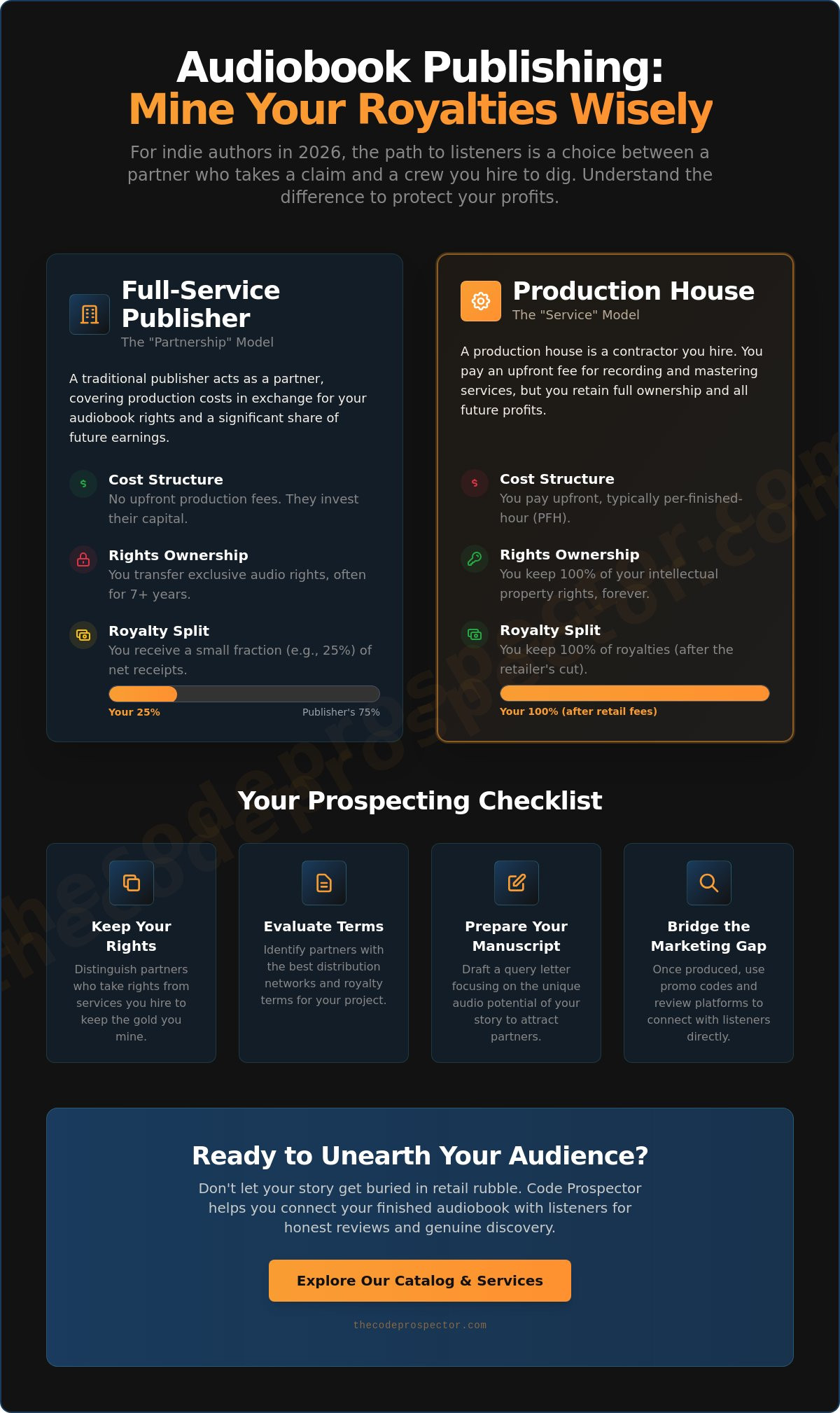
Audiobook publishing companies generally fall into two camps: those that buy your story and those that sell you a service. A full-service publisher pays for production but keeps your rights and a massive chunk of your royalties. A production house charges an upfront fee but lets you keep every cent of your earnings from retailers like Audible.
The "free" production offered by traditional publishers hides a high long-term cost. You might trade 75 percent of your lifetime royalties just to avoid an initial production bill. This trade-off only makes sense if you lack the capital to start your own dig or need the prestige of a specific label.
You can tell a company is trying to buy your story when they offer an advance or royalty share. If they ask for a flat fee for "distribution" or "formatting," they are selling you a service. We help authors bridge this gap by connecting them with listeners for honest reviews on the Code Prospector catalog.
When to choose a production company
Paying for narration upfront allows you to retain 100 percent of your gold. You maintain total control over your audiobook production quality and narrator selection. You don't have to settle for a voice that doesn't fit your vision just because a publisher has them on staff.
This path also bypasses the long wait times of traditional publisher schedules. While a large publisher might sit on your manuscript for 12 months, a production house can often finish your project in 60 days. This speed allows you to capitalize on current trends before the market shifts or your audience loses interest.
The benefits of a full-service publisher
Publishers provide access to professional editing and sound engineering without out-of-pocket expenses. They offer marketing support that can help unearth your book from the bottom of search results. These companies also handle legal protection and copyright management in international markets, which saves you from complex legal headaches.
A reputable publisher buys your story because they see its potential value. If a company asks for "marketing fees" while also taking your rights, they are likely a vanity press rather than a true publisher. We recommend you compare your options carefully before signing away your intellectual property.
Evaluating major players and independent alternatives
If you are an indie author trying to find the best home for your narrated story, you need to know which mines are worth digging in. Choosing the right partner from the available audiobook publishing companies determines whether your story reaches millions or sits gathering dust in a digital vault. You must understand that these companies operate on vastly different scales, from global conglomerates to specialized niche houses.
The Big 5 publishers represent the deepest veins in the industry, housing imprints like Penguin Random House Audio and Macmillan Audio. These giants offer unmatched prestige and massive marketing budgets, but they rarely talk to anyone without a literary agent. They focus on high-volume hits, meaning your project must show massive potential before they even pick up a shovel.
RBmedia stands as the largest independent producer, using a network that spans Audible, Spotify, and local libraries to reach millions of listeners. Blackstone Publishing also provides a heavy-hitting alternative, offering distribution that rivals the Big 5 while remaining more accessible to certain high-performing creators. These companies act as the heavy machinery of the industry, moving large quantities of content through established pipelines.
According to audiobook sales statistics from December 2024, the industry continues to show resilience despite monthly market shifts. This growth allows hybrid models to thrive, giving you a middle ground where you retain more control while still accessing professional production. Hybrid firms often provide the tools you need to polish your work without demanding you sign away all your rights.
The giants of the industry
Working with Simon & Schuster or Macmillan Audio puts your work in the same category as global bestsellers. These publishers control the most valuable real estate on retail platforms and have direct lines to major media reviewers. However, their gatekeeping is strict, and you will almost certainly need an established agent to submit your work. They prefer to prospect in territories where the gold is already visible, such as books with high print sales.
Independent and niche gems
Podium Publishing has unearthed massive success by focusing specifically on science fiction and fantasy titles. They understand the "LitRPG" and "spicy" romance subgenres better than the corporate giants do. Dreamscape Media provides another excellent route, particularly if you want to see your work in the library market and retail channels simultaneously. These audiobook publishing companies often take more risks on unique voices that the Big 5 might overlook.
Finding a niche publisher ensures your marketing aligns with what your specific listeners actually want. We see this play out on Code Prospector every day, where specialized stories often find more dedicated reviewers than generic blockbusters. You can view our author resources to see how we help you build momentum regardless of which publisher you choose.
Visit our comparison page to evaluate how different distribution paths impact your potential reach.
Preparing your manuscript for the prospecting process
As an indie author, you need to treat your manuscript like a raw vein of gold waiting for the right refinery. Most audiobook publishing companies receive hundreds of submissions every month, so your pitch must stand out by proving your story works in an auditory format. You should start by drafting a query letter that highlights the specific rhythm and dialogue-heavy nature of your prose. This document acts as your prospecting report, showing publishers exactly where the value lies.
Before you reach out, spend at least one hour digging through the company's existing catalog. Look for titles that mirror your tone or target the same demographic. If you find a gap in their list that your book fills, mention it. This shows you're a partner who does the work rather than someone just blasting out generic emails. You want to prove that your book isn't just another piece of rubble, but a high-value asset.
Creating a professional retail sample is another vital step in the prospecting process. This five minute audio clip should showcase the specific voice and tone of your story. It serves as the gold sample that proves the quality of the material you're offering to audiobook publishing companies. A strong sample helps a publisher visualize the final product and reduces the perceived risk of the investment.
Polishing your pitch for audio
Your pitch needs hard data to back up your creative claims. Include your ebook sales figures from the last 90 days or mention the 1,200 followers you have on your primary social media channel. You can use our for-authors resources to identify current market trends that make your genre a safe bet for a publisher. Publishers want to see that you already have a listener base ready to use their Audible credits on your work.
Mention any existing reviews that specifically praise your dialogue or character voices. If listeners already love the way your characters speak, a publisher will see the potential for a hit performance. Highlighting your existing reach proves you're a proactive partner in the marketing process. This transparency builds the trust necessary for a long-term professional relationship.
The technical requirements of a submission
A manuscript meant for the eyes often contains traps for a narrator. You must strip out visual cues like "see the chart on page 42" or "as pictured above" before you submit your files. Create a character list that includes a pronunciation guide for every name and fictional location. This guide prevents costly retakes and shows the publisher you understand the technical labor of production.
Clearly define your target audience and genre so the company knows exactly which shelf your story belongs on. Provide a clear summary that highlights the "hooks" that translate well to audio, such as intense action or lyrical narration. Following the submission guidelines exactly is the only way to avoid the immediate rejection pile. Most companies have a zero-tolerance policy for messy submissions that ignore their specific formatting rules.
To see how your story stacks up against current hits, browse the latest indie releases in our audiobook catalog.
Moving from a signed contract to active listener discovery
Signing a contract with one of the many audiobook publishing companies feels like you finally struck a rich vein of gold. The ink on that page represents the start of the excavation, not the end of your journey. You must prepare to dig deeper to ensure listeners actually find your work in a crowded marketplace. Many authors realize too late that the contract is simply the permit to mine, while the actual prospecting for listeners remains their responsibility.
Most publishers focus their energy on the initial technical upload and broad distribution logistics. They rarely provide the sustained, grassroots marketing required to keep a title visible after the launch week. This creates a marketing gap where your title can easily get buried under new rubble if you do not take control. You should expect to spend at least 10 hours a week on discovery efforts during your launch month to maintain momentum.
While audiobook publishing companies handle the logistics of getting your file onto platforms, they do not guarantee that anyone will press play. You need to bridge this gap by building a direct connection with your audience. Think of your publishing deal as the foundation of a structure that you must still build and furnish yourself. Active discovery involves more than just posting on social media; it requires a systematic approach to gathering social proof.
Managing your own discovery
You cannot rely solely on a publisher to find your audience in a sea of thousands of monthly releases. New titles require a steady stream of honest reviews on Audible to trigger the algorithms that suggest your book to others. These reviews act as markers for other listeners, signaling that your content is worth their time and credits. We built a system that allows you to distribute promo codes safely to listeners who actually want to hear your story.
Our platform ensures that your promo codes reach humans rather than bots or resellers who might clutter your data. By placing your work in front of verified enthusiasts, you generate the early feedback necessary to climb the charts. This process ensures your launch does not stall in the dark tunnels of the back catalog. You maintain full control over who receives your work, protecting your intellectual property while building your reputation.
Building a sustainable author career
Long-term success in this industry requires more than a single successful launch. You can use our audible promo code guide to maximize your reach across every title you produce. Our dashboard provides the tools to track your progress and see exactly how your codes perform in real time. This data allows you to refine your strategy for future releases and avoid wasting resources on ineffective channels.
You also gain access to a verified network of listeners in our catalog who are eager to discover their next favorite narrator or author. Connecting with these listeners helps you build a loyal fan base that will follow you from one project to the next. Consistency is the key to unearthing the true value of your publishing contract over several years. Every review you gather acts as a lantern for the next listener, making your path to success much clearer.
Start your next campaign by browsing our community of verified listeners to see how we can help you grow your audience.
Stop burying your potential in the rubble
Navigating the landscape of audiobook publishing companies doesn't have to feel like wandering through a dark mine without a lantern. You now have the tools to distinguish between simple production houses and the strategic partners who will help you scale your reach. Remember that your manuscript is the raw material, but your marketing strategy is the machinery that extracts the gold. By preparing your files for the 2026 standards and vetting your partners carefully, you protect your intellectual property from becoming buried under technical debt.
Once you finish the recording, we help you move from a finished file to a discovered masterpiece. Our system connects you with a verified network of listeners using safe promo code distribution tools that protect your royalties. We built this platform as indie authors for indie authors to ensure your hard work finds its way into the right ears within 14 days of your launch. Your story deserves to be heard, and the right tools make all the difference.
Join Code Prospector to start unearthing your audience today
Frequently asked questions about audiobook publishing
What do audiobook publishing companies actually do for authors?
As an indie author, you need to know that these companies act as the master refiners of your raw manuscript. They handle the heavy machinery of production, from casting professional narrators to final audio engineering. These partners often cover the upfront recording costs, which saves you from spending $3,000 to $5,000 on a studio. By navigating the complex tunnels of distribution, audiobook publishing companies ensure your story reaches listeners on Spotify and Apple Books.
How much does it cost to work with an audiobook publisher?
You typically pay for their expertise through a royalty-sharing agreement rather than a flat fee. Most traditional houses take a 20% to 50% cut of your net earnings in exchange for funding the production and marketing. If you choose a hybrid model, you might pay an upfront cost of $200 to $400 per finished hour for narration and editing. We recommend checking our page to compare audiobook production paths to see how different deals impact your long-term gold reserves.
Can I publish my audiobook on Audible without a company?
You can publish directly on Audible by using the ACX platform as an independent creator. This path allows you to retain 40% of your royalties if you choose an exclusive distribution deal or 25% if you want to sell on other platforms. You must manage the narrator search and quality control yourself to ensure the audio meets strict submission requirements. While this DIY approach keeps more gold in your pocket, it requires you to act as your own project manager throughout the excavation process.
Do I need an agent to get an audiobook publishing deal?
You don't need a literary agent to secure a deal with many independent audiobook publishing companies. While the largest publishers usually require an agent to open the door, dozens of mid-size houses accept direct queries from indie authors. You should prepare a professional pitch that includes your sales data from the ebook version to prove there is value in your work. Providing a clear marketing plan increases your chances of a successful partnership without a middleman.
How long does the publishing process take from start to finish?
The journey from a finished manuscript to a live audiobook usually takes 3 to 6 months. This timeline accounts for the 4 to 8 weeks needed for narration and the 10 to 14 days required for quality assurance checks. Major platforms like Audible often have a backlog that can add another 30 days to the release date. Mapping out your production schedule early helps you avoid the cave-ins of missed deadlines and rushed releases.
What is the difference between a publisher and a distributor like ACX?
A publisher acts as your full-service mining crew, while a distributor like ACX is the rail line that carries your finished ore to the market. Publishers invest in the narration, cover art, and marketing of your book to maximize its value. Distributors simply provide the technology to host your files and send them to retail storefronts. Code Prospector helps you bridge this gap by connecting your finished product with listeners who provide the honest reviews needed to boost your visibility.
Will a publishing company help me get more reviews on Amazon?
Most audiobook publishing companies focus on distribution and high-level marketing rather than individual review acquisition. They might send your book to a small list of internal reviewers, but they rarely guarantee a specific number of stars on Amazon or Audible. This is where we come in. You can use Code Prospector to distribute promo codes to our community of dedicated listeners, ensuring your audiobook gets the early feedback it needs to climb the charts.
Visit our catalog to see how we help indie authors find their audience and unearth the true value of their audiobooks.

Article by
Kimberly Cordova
Kimberly Cordova is the founder of Code Prospector, the membership platform where indie audiobook authors distribute Audible and Findaway Voices promo codes to listeners who actually want to leave honest reviews.
She started Code Prospector after watching too many indie authors pour a year into producing an audiobook, launch it, then disappear into the void without the reviews they needed to stay visible. The books were not the problem. The review ecosystem for indie audiobooks simply did not exist. So she built one.
On the blog, Kimberly writes about what actually works for indie audiobook authors: review strategy that does not feel sleazy, promo code distribution that respects Audible's terms, catalog positioning, and the marketing moves that keep a title selling long after launch. She also writes for listeners, because listeners are the reason the whole platform works. Her focus is practical, honest, and rooted in what real authors and real audiobook fans are actually doing, not theory or recycled marketing advice.
Kimberly also runs Thrive Collective, a portfolio of publishing and creative businesses, which keeps her in the weeds of indie publishing, audiobook marketing, and community building every day. She believes indie authors deserve better tools, better promotion, and a review ecosystem that does not require begging strangers on Facebook.
When she is not building Code Prospector, you will usually find her buried in a new audiobook, running ads for her publishing catalog, or overthinking how to make life easier for the people who create and love audiobooks.